

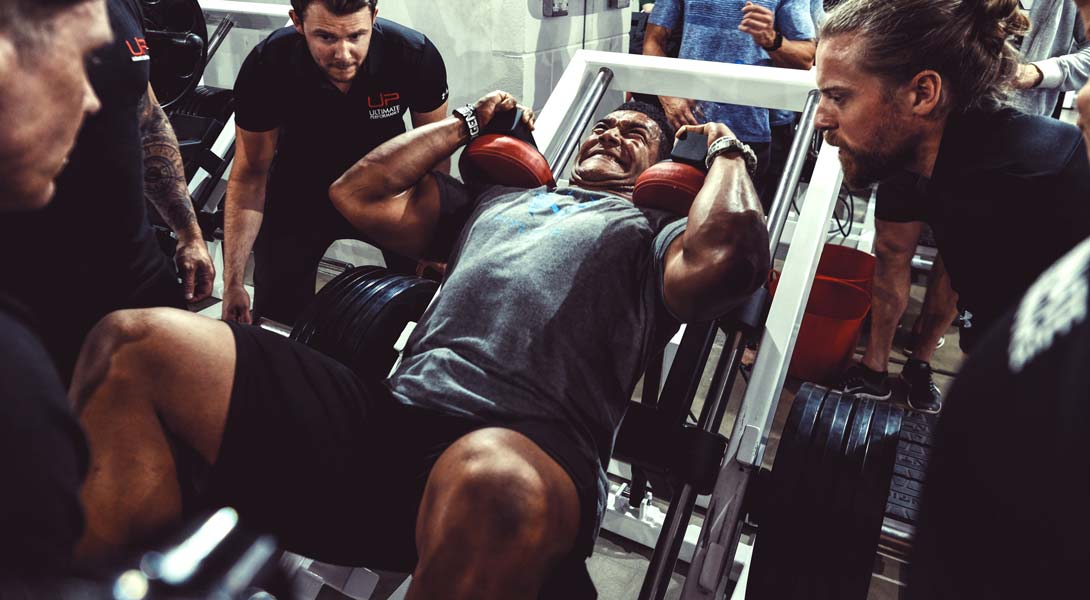
If there’s one thing that separates the boys from the men in the weight room, it’s leg day.
It’s also the one day that really lends itself to experimenting and running wild with different programming variables.
From giant sets to high-intensity techniques, there are countless ways we can shock the legs into hypertrophy.

START YOUR BODY TRANSFORMATION JOURNEY TODAY!
The problem is, most guys will half-ass their leg training in favour of training those coveted chest and bicep muscles.
So, here we will be talking to UP Personal Trainer Adam Hayley, a competitive bodybuilder who over the years has managed to transform his bowling pins into a pair of wheels that blow most of his competition away when stood on stage.

What are the three main programming considerations you’ve taken into account when building YOUR legs?
Okay, so these are very specific to my own structure; bearing in mind I have short femurs and tibias, but a very long torso, relatively speaking.
- Exercise structure and variations to keep my lower back from ‘pumping’ too much.
- Keeping it hamstring/quad-focused and minimising glute development through altered range of motion.
- Putting emphasis on hamstrings first in the workout (they were under-developed compared to my quads).
When programming for an individual’s leg workouts, body structure may be one of the most important things to take into consideration.
While someone like Adam with short femurs would normally be at an advantage with leg training, his long torso means forces through the lower back can increase dramatically if certain exercises aren’t tweaked to match his structure.

By doing things like shortening the range of motion on exercises such as squats (going to just below parallel, rather than super deep), he can effectively train the muscles he wants to without creating compensations.
The third point raised will apply to almost every reader on here. Besides competitive bodybuilders, most trainees have almost non-existent, or very lagging hamstring development.
One ‘trick’ to implement is to start your workouts with hamstrings. This could be as simple as using a leg curl or glute ham raise variation as your ‘A’ exercise. It’s important to remember that what you do first in the workout will always get the most benefit.
For you readers, we would advise the following sequence in your leg workouts: calves > hamstrings > quads.
So why hamstrings first? And how should you train them?
Besides the benefit of being able to apply real intensity to the hamstrings, a less well-known advantage is that training your hamstrings first will make your squats, and quad-dominant work ‘feel’ a lot better.
Coaches such as Charles Poliquin and Louie Simmons have been giving this advice for years now. Warmer knees, more-cushioned squats, and bringing up a common weak body part are all reasons for training them at the beginning.
When it comes to training the hamstrings, we need to take into account their actions and widely mixed-fibre-type composition.
Anatomically, the hamstrings serve two key functions: knee flexion (via leg curls and glute ham raise variations) and hip extension (via good mornings, Romanian deadlifts, reverse hypers, etc.).
A typical mistake many will make is only training the hamstrings in knee flexion, through various types of leg curls. This mistake will leave a lot of hamstring development on the table.
In terms of its fibre type makeup, it’s often stated that the knee flexors are primarily fast twitch, and shouldn’t be trained with anything more than eight reps.
From an athletic and performance standpoint this may be true, but from a bodybuilding standpoint, there may be more to it.
Bodybuilders have some of the biggest hamstrings around, so perhaps there’s something to be learnt from using a wide variety of rep ranges in not only hip extension movements, but in leg curl variations too.
Now that we’ve covered hamstrings, what about the question floating on all your minds – Do you have to squat?
We asked Adam…
No. Although if biomechanically you’re sound to do so – I think they’re a great exercise.
On the other hand, if your form isn’t quite right, or you aren’t quite built for it, I don’t think the benefits they give would potentially outweigh the risks.
There’s no denying that if you can squat, and squat efficiently, there’s no exercise that will be more effective at packing on mass in your legs.
For the past century, bodybuilders have been doing high rep squats to build their legs.
For example, 20-rep ‘breathing squats’, one of the most brutal programmes ever written, was centred purely on heavy, high-rep squats.
Dating back to the 1930s, it was popularised by Mark Berry, Pear Rader, John McCallum and Joseph Hise as the ultimate way to build muscular bulk in the body.
Tom Platz, the owner of the best legs of all time, credited his size to his high-rep squatting feats, including his legendary video where he squatted 500lbs for 23 reps.

However, no exercise is indispensable. The squat is certainly no exception. When we consider a trainee who isn’t structurally built to squat (think long femurs, tibias, and a short torso) a lot of the stress will tend to go to the hips and back.
For these guys, a standard back squat may not be the answer. Instead, looking at variations such as the safety bar squat, front squat and machine squat where the torso can be kept more upright and fixed, will transfer more stress to the legs.
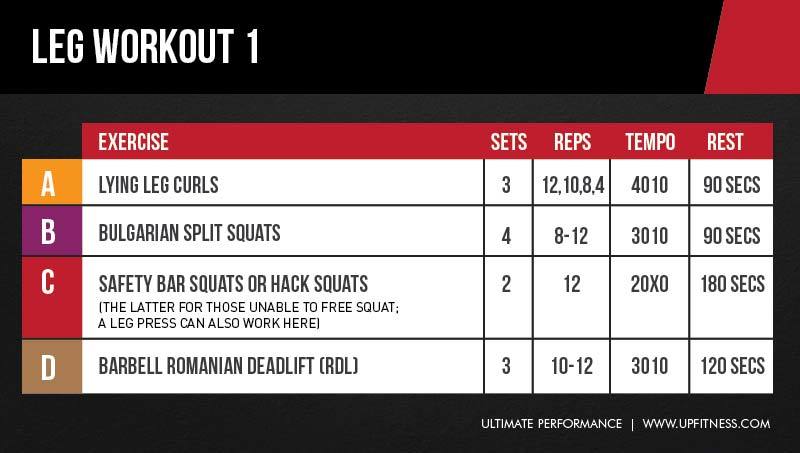
If we put this into practice, it could look something like this:
What’s your favourite and most underrated leg exercise and why?
Walking lunges. They trash everything: quads, hams and glutes.
Just keep an eye on form – don’t ‘fall’ forward at the torso and ‘peel’ yourself back up…and keep an eye on knee tracking.
What are the three biggest mistakes you’ve made in building a bigger set of legs?
1) Chasing one-rep maxes. Increasing strength is essential to progress, but I’d question whether <3 reps are needed.
2) Quarter reps for the sake of stroking your ego.
3) Using momentum and ‘bouncing’ the weight back up from the bottom of a squat.
Number one will resonate with many people and explains why the best bodybuilders will have bigger legs than the best powerlifters. Longer time under tension, utilising mind-muscle connection, and intensification methods are some of the factors explaining the differences here.
Yes, strength is important. However, what’s more important is that you develop the right type of strength. In the case of building muscle, strength for moderate to high reps will be more effective.
This brings us onto intensification methods. Drop sets, negatives, rest-pause; the list (and the pain) goes on.
Used correctly and in a periodised manner, these methods can take your quest for hypertrophy to the next level.
For leg training, it can be the moneymaker.
An example is the ‘strip set’ on the leg press.
Warm up and work up to a true 10-rep max on the leg press. From here, without locking the sled, ask a training partner to start stripping plates off. How many drops you do and plates you strips depends, but anywhere from three to five ‘strips’ of one to two plates will do the trick.
What is the number one ‘secret’ tip you could give that we could implement straight away into our next leg workout?
Use a mix of high (15-50) and low (5-8) reps. Start off the workout with relatively heavy squats for example, and finish on 20-plus-rep leg extensions or even 100-rep leg presses.
Don’t leave any stone unturned, or get pigeon-holed into any one way of training.
Great, so how can we implement all this into a workout?
Here’s a workout I like to do quite often:

Why do I like this? It covers all your bases.
You have the ‘heavy’ work at the beginning. Notice how I start with hamstrings and keep it paired with the squats.
Second, I like to destroy the quads with some tri-sets. The huge amounts of metabolic stress and blood flow will create a tonne of muscular tension and breakdown.
Third, back to hamstrings, but this time focusing on the hip extension portion, and specifically, the stretched position.
To finish with, an all out set of 50 reps on the leg press. You can rest-pause this two or three times in order to hit the rep, but you can’t lock the sled! This will trash your legs and by now, every muscle fibre will be destroyed.
All you need to do now is go home and eat!
Training legs is tough, there’s no doubt about it. It separates the boys from the men in the weight room, and there aren’t many things more impressive than a well-built set of thighs.
If leg day motivational videos are what you need, look no further than our infamous UP leg workout that UP Personal Trainer James ‘Thor’ Wallace completed…